21st Marine Expeditionary Unit
Created by Colonel Nicholas Means III on Thu Feb 11, 2021 @ 4:58am
21st Marine Expeditionary Unit (MEU)
The 21st MEU operates both aboard Deep Space 5 (on decks 72-73) and on the planet Pangaea. A MEU is unique in that its air/space and ground combat elements are combined with a logistics combat element under one commander. With the Marines being Starfleet's 'Force in readiness' they stand ready to defend the station hand in hand with station security, or deploy where ever and when ever needed.
- Troop Strength: 1200 Marines

Organizational Structure
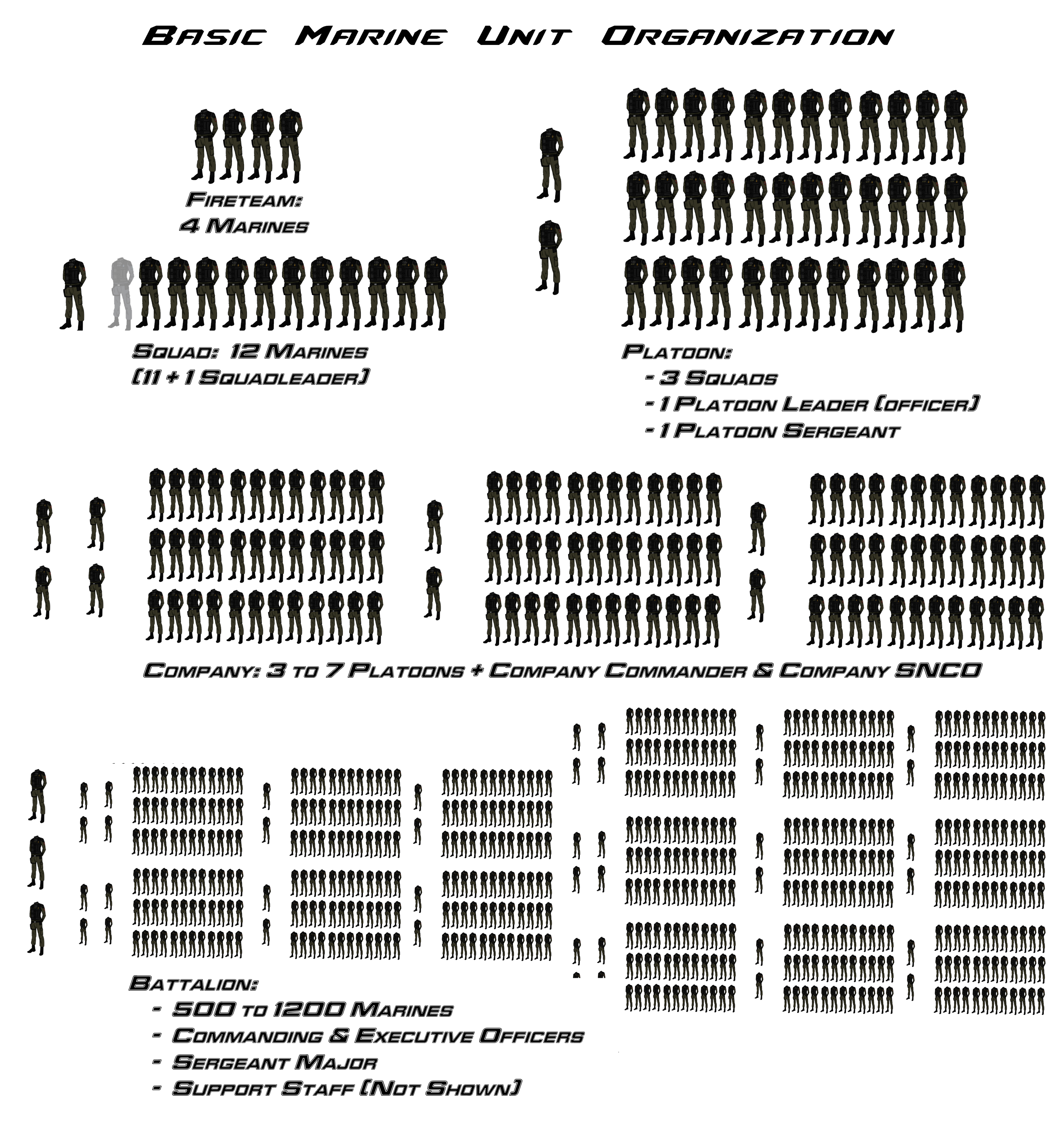
Click to enlarge image

Organizational Elements
Command Element
The element consisting of the MEU Commanding Officer and supporting staff, provides command and control over the other elements. This element is comprised of approximately 80 Marines.- HQ&SVC Company:
- - Command Staff:
- - CO/XO/SgtMaj
- - 7 Company Commanders (separate form Command element personnel)
- - MEU operational staff
- - Operations
- Personnel Administration
- Supply Transfer Monitor
- - Operations
- - Command Staff:
Ground Element
An element consisting of Marines whose sole purpose is combat related. Principal operations consist of but are not limited to boarding operations, station defense, ground operations, and security.- 4 Companies totaling 770 Marines
- 3 Traditional “Rifle” Companies
- - Alpha Co.
- Bravo Co.
- Charlie Co.
- - Alpha Co.
- 1 Special Weapons Company (consisting of Recon, Fast reaction, Surveillance, and Hostage Rescue assets)
- - Delta Co.
- 3 Traditional “Rifle” Companies
Space Element
A fighter and transport element that provides the 21st MEU attack, defense, and transport capabilities. Allowing the 21st MEU to operate independently of, and freeing other, station resources, but ready to conduct joint operations when called upon. Consisting of:- 2 Companies totaling 232 Marines
- 3 Fighter Squadrons
- - Alpha Squadron – The Kukri
- 12 - Razor Interceptors
- 12 - Valkyrie Space Superiority Fighters
- 12 - Broadsword Multi-role Assault Fighters
- Maintenance and Ordinance Crews - 56 Marines
- - Alpha Squadron – The Kukri
- 3 Transport Squadrons
- - Echo Squadron – The Raiders
- 15 Wyvern Hopper Transports, 2-man crew
- 15 Wyvern Hopper 2-man crews
- 6 Wyvern Med Variant 4-man crews
- - Echo Squadron – The Raiders
- 3 Fighter Squadrons
Logistics Element
This element consists of specialized units such as heavy equipment, Combat engineering support, explosive ordinance disposal, etc…- 1 Company totaling 154 Marines
- - Echo Co.
Vehicles
Ground Vehicles
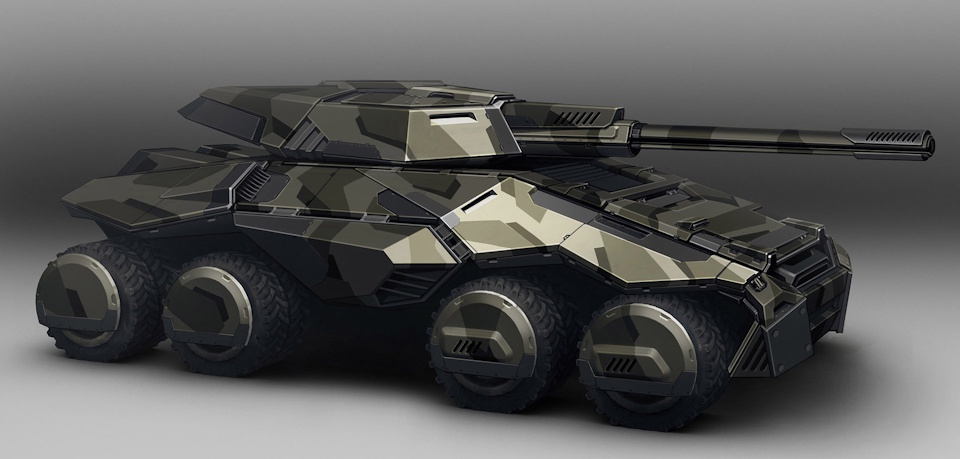
Kraken Armored Assault Tank (KAAT)
Personnel
Crew: 4 (Commander, Driver, Gunner, Loader)
Dimensions
Length: 8 meters, Gun Forward 9.75meters
Width: 3.6 meters
Height: 2.5 meters
Armament
Main Gun: Plasma/Particle Energy Cannon
Secondary Weapons: Phaser Repeaters (Port/Starboard) : 2 (fires 600 pulses/minute)
Anti-Air: Mk XII Surface-to-Air phaser striping
Description:
The Kraken or KAAT is the SFMC’s answer to a fundamental need for heavy support equipment on the surface of a planet. Particularly useful against other heavy equipment and in terrains or situations where orbital support is not an option. The Kraken is primarily a Main Battle Tank but can operate in support of infantry personnel as needed. Designed to withstand even the heaviest bombardment, the Kraken is intended to be left in the field with the expectation that she won’t return to Camp until the mission is complete.
Furnished with replicators to support the internal crew, and enough munitions to last through most extended engagements. For those engagements that last longer, she is fitted with transporter amplifiers to aide with resupply from a support vessel.
Encased in ablative hull armor, the Kraken is able to withstand most weapons fire, and heavy armor plating beneath serves as secondary protection. Within the protection of these sheets of armor, the Kraken is also protected from EMP/Electronic Warfare rounds, sealing the crew inside a protective cocoon.
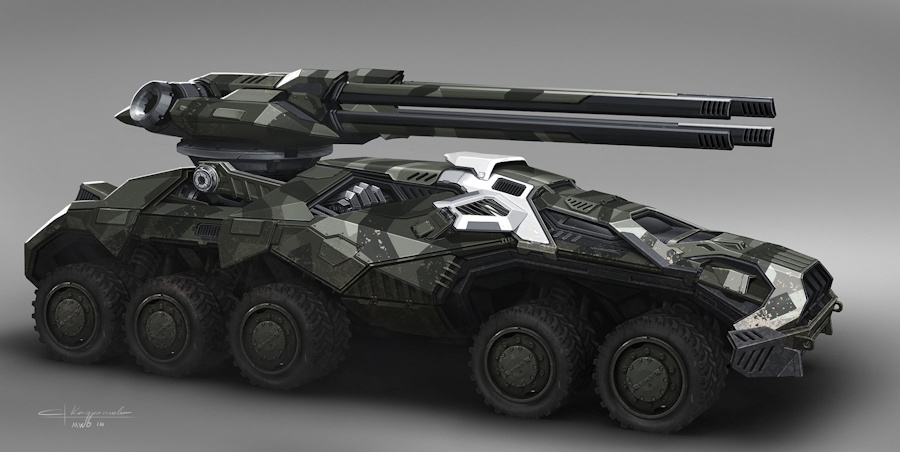
The Epirus II Mobile Long-Range Artillery Platform
Personnel
Crew: 5 (Commander, Driver, Loader, Gunner, Assistant Gunner/Communications)
Dimensions
Weight: 5,418 Lbs.
Length: 12 Meters
Barrel Length: 9 Meters
Width: 5 Meters
Height: Variable.
Armament
Main Gun: 175mm Indirect Plasma Energy Cannon
Firing Arch: 180 degrees
Ammunition:
- Shaped Plasma Charge - Capable of 5 rounds per Cartridge before replacement. Standard fire rate of 10 per minute, maximum fire rate of 20 per minute.
- Plasma Charge - Capable of 5 rounds per Cartridge before replacement. Standard fire rate of 10 per minute, maximum fire rate of 20 per minute.
Effective Range
80 Kilometers
Defensive:
Ablative Armor
Description:
The Epirus Mobile Artillery platform is a mobile Artillery weapon in use by the Starfleet Marine Corps. Its development started during the early years of the Dominion War when the Marine Corps saw a need to replace its aging artillery platforms. The Epirus is a mobile, highly accuracy artillery platform capable of providing offensive or defensive fire support to Marine personnel in the battle field. It is best operated in groups of 4 for maximum effect.
Made out of a Duranium composite, the platform is lightweight and can take a beating before it becomes inoperable. That being said, the Epirus should never be left undefended by any account, it usually deployed at a Forward Operating Base or a dug-in firing position. If neither of these are available within the Operating Area, its best to conceal and defend them by whatever means necessary.
The Epirus fires highly charged, shaped plasma projectiles from an ejectable 5 shot cartridge before it must be replaced. Because of the shaped nature of the plasma charge, the Epirus has an operational range of up to 80 kilometers before the plasma charge's dissipation makes the shot ineffective. Targeting is achieved via a grid system relayed from the forward observer calling in the fire mission, for more pinpoint accuracy, sensor readings from orbiting starships, fighters or Recon assets can be used in conjunction with the LCARS IX Digital Fire Management System. To stabilize the Epirus when operating and counteract recoil the platform has four stabilizing jacks at the vehicles compass points.
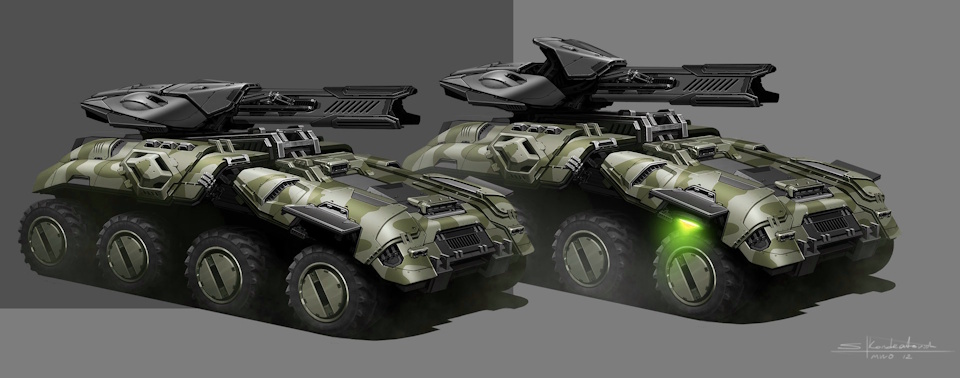
The Trident IV Mobile Short-Range Artillery Platform
Personnel:
Crew: 3 (Commander/Driver, Gunner, Assistant Gunner/Communication)
Dimensions:
Length: 8 Meters
Barrel Length: 4 Meters
Width: 4 Meters
Height: Variable.
Armament
Main Gun: 175mm Indirect Plasma Energy Cannon
Firing Arch: 180 degrees
Ammunition:
- Plasma Charge - Capable of 5 rounds per Cartridge before replacement. Standard fire rate of 10 per minute, maximum fire rate of 20 per minute.
Effective Range:
25 Kilometers
Defensive:
Ablative Armour
Description:
A smaller, faster, and more mobile version of the Epirus, the Trident is designed to fire on the move. The Trident's versatility allows for a wide array of missions both defensive and offensive.
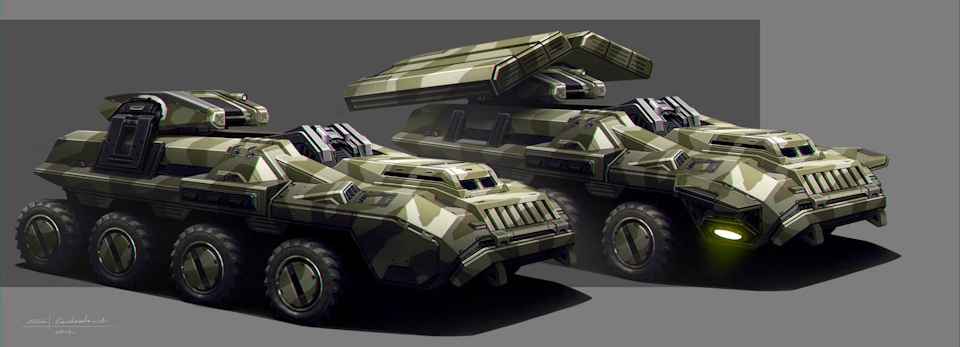
Aegis Sub-orbital Surface-to-air Platform (ASSP)
Personnel
Crew: 4 (Commander, Driver, Gunner, Targeting/Communications)
Dimensions
Length: 12 Meters
Width: 5 Meters
Height: Variable.
Effective Range:
100 Kilometers
Description:
Armed with either a battery of 6, 12, or 18 photonic missiles the Aegis platform was primarily designed, like it's ancient namesake, to protect critical assets.
Like many of the SFMC other vehicles, it to is made out of a Duranium composite, the platform is lightweight and can take a beating before it becomes inoperable. Best if operated from a concealed, shielded, or other protected position. The targeting system on the Aegis is capable of independently tracking and targeting anything in the air within it's operational range. Able to fire single missile or a barrage the Aegis can strike with pin point accuracy or saturate and overwhelm a target. To stabilize the Aegis the platform has three stabilizing anchors per side and a side wide anchor in the rear.
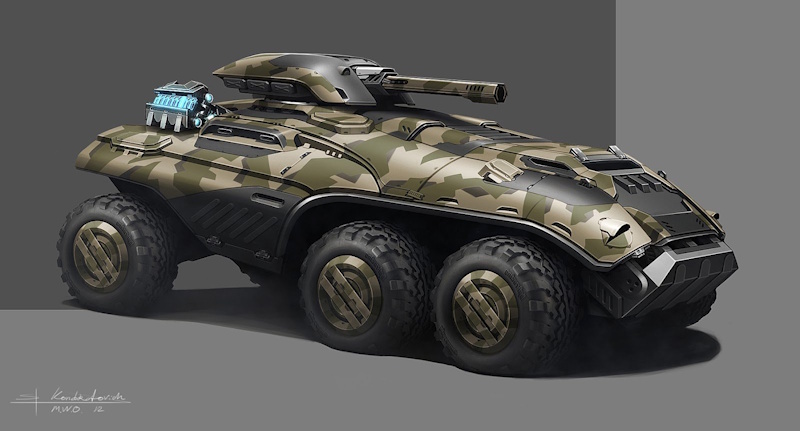
Stryker Squad Assault Vehicle
Personnel
Crew: 3 (Commander, Driver, Load Master/Gunner)
Passengers: Maximum of 12
Dimensions
Weight: 16
Length: 10.1 meters
Width: 2.6 Meters
Height: 3.4 Meters
Armament:
1 x Phaser Repeater - Controlled by the Load Master in a rear facing RWCs.
Defensive:
Ablative Armour
Description:
The Rear of the Stryker is a deceptively large space, capable of fitting up to 12 marines with their gear. When not transporting Marines it can be configured to carry up to three palettes of munitions or other supplies. Located along the side of the rear compartment is a small transporter that has the ability to be linked in tandem to other squad of vehicles, thus transporting supplies to vehicles on the front. This transporter has a range of 5 kilometers.
Bandit Fast Attack Vehicle
Personnel
Crew: 2-4 (operable with just one)
Dimensions
Length: 5 meters
Width: 2.1 meters
Height: 1.9 meters
Armament
Type IV Remote Controlled Phaser Canon with Integrated Mark 25 Revolving Grenade Launcher: 1 (Tactical Variant Only)
Description
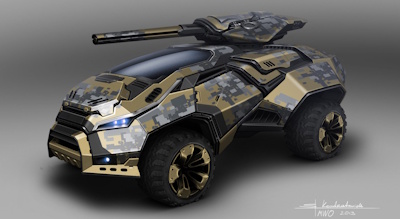
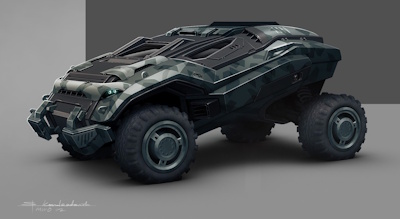
The Bandit Class fast recon vehicle was built to bridge the gap between the ARGO-ATV and the more cumbersome large vehicles in use the the SFMC. The Bandit is designed to be used as a fast recon vehicle to move quickly to the edge of enemy lines and beyond.
It has puncture resistant, all-terrain, large tires that make it possible to maneuver across nearly all types of ground, even under high speeds, although this should only be done in emergencies. However, it has the capability of lifting off the ground in emergencies but only with enough power for very short bursts and no more than a maximum of 1 meter off the ground...for example where the path ahead is too broken or damaged to drive over and the vehicle has need to clear the obstacle ahead.
In its base configuration, the Bandit has a crew of 3 Marines with a fourth available to assist in recon/terrain scanning as needed. The forward cockpit houses the driver and navigation Marine while the rear compartment houses the fire control marine (Tactical Variant) and/or two supporting Marines for field recon beyond the range of the Bandit or special operations as needed.
Configurations:
- Base Configuration: Fast Scout
- Tactical Configuration: Mobile Infantry Support/Close-range artillery support.
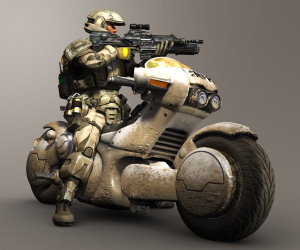
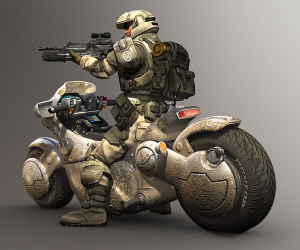
Individual Recon Assault Bike
Fighters & Transports
Peregrine Strike Fighter
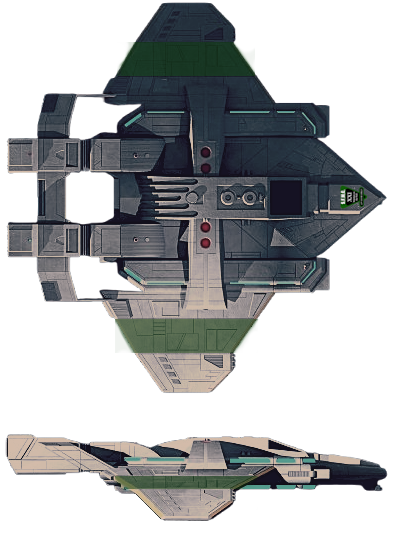
The battle tested workhorse of Starfleet's fighter craft. Having seen combat in the Dominion war, the Peregrine has continued to prove itself over and over again. Used as an Academy train, by civilians, and even the Maquis; the Peregrine class made be aging but still in demand.
Currently, only a handful of squadrons operate the aging Peregrine. Starfleet has insisted that the class will be retired by 2405, but there is a push from several current and former pilots and squadron commanders to extend the service life and even put the class back into limited production.
Crew: 1
Propulsion:
impulse engines: 2
warp nacelles: 2
- cruising speed: Warp 4
- maximum speed: Warp 6
- emergency speed: Warp 6.5 (30 minutes)
Basic Weapons Loadout:
- 2 Type-U+ Micro-pulse phaser cannon dual mounted on wing
- 1 Aft Type-VII phaser bank
- 1 Forward, nose & 1 micro-torpedo launchers; 10 torpedoes each
Defenses:
- Duranium with Regenerative ablative armor
- Auto modulating Shields
- Emergency Transporter for 1
Valkyrie Multirole Fighter
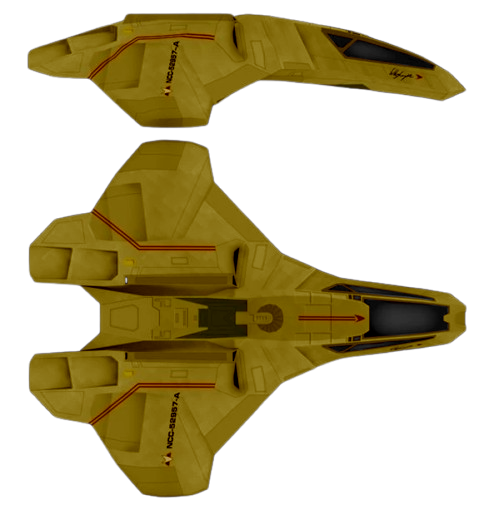
The Valkyrie is designed to function in a multitude of environments as well as roles. To be capable in all the varied conditions the systems are designed with flexibility, versatility, and stability in mind.
Propulsion:
impulse engines: 1
warp nacelles: 2
- cruising speed: Warp 2
- maximum speed: Warp 4
- emergency speed: Warp 4.5 (30 minutes)
Basic Weapons Loadout:
- 3 Type-VIII phaser banks (2 fore facing on the face of wing sides; 1 aft between impulse assemblies)
- 5 micro torpedoes, forward firing
Defenses:
- Duranium with Regenerative ablative armor
- Auto modulating Shields
- Emergency Transporter for 1
Gryphon Class Superiority Fighter (aka the Broadsword)
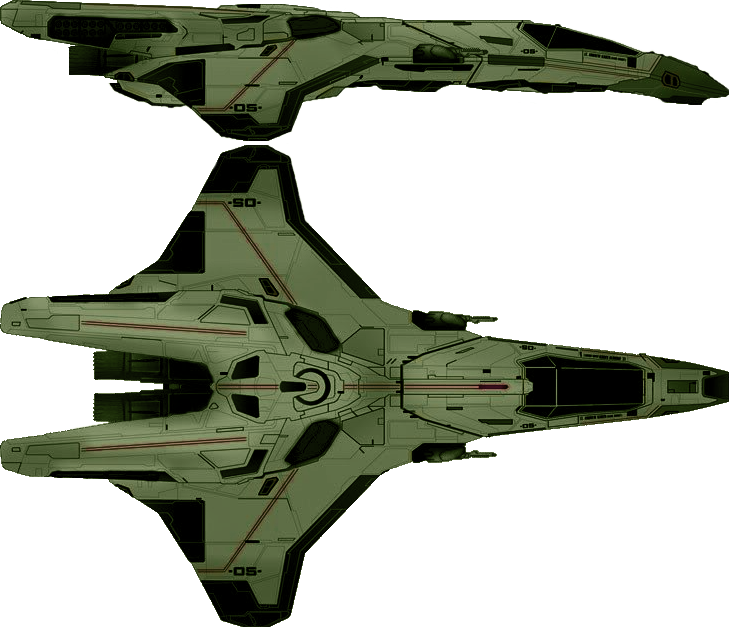
The Gryphon started life as an enlarged Valkyrie, capable of faster speeds, better shielding, and more offensive weaponry. As the design evolved, it took on a look all its own. Designed to function in a multitude of environments as well as roles, the primarily role for the Gryphon is as a superiority fighter.
The Gryphon, unlike other Starfleet Fighters, is a two-person craft. This improves pilot efficiency by allowing the pilot to focus solely on the maneuvers and weapons deployment of the craft during a fight. The Tactical Intercept Officer (TIO) handles comm traffic, coordination with other fighters and ships, emergency repairs, counter-measure deployment, and tactic simulations.
Propulsion:
impulse engines: 1
warp nacelles: 2
- cruising speed: Warp 3
- maximum speed: Warp 5.2
- emergency speed: Warp 5.5 (30 minutes)
Basic Weapons Loadout:
- 2 Type-U+ pulse phaser emitters
- 16 micro torpedoes, forward firing
Capable of carrying a wide various of additional, external under wing ordinance.
Defenses:
- Duranium with Regenerative ablative armor
- Auto modulating Shields
- Emergency Transporter for 2
Wyvern Personnel Transport
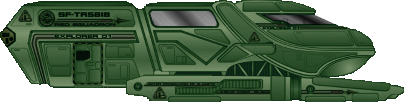
The Wyvern came in several variants, the standard version was built to carry around 30 troops from orbit to the surface and from various locations on the ground. The transport lacks a warp drive and needs to be ferried from system to system by a warp capable vessel.
They were equipped with a number of personnel transporters to allow for quick deployment. If transporters were unusable the craft had a number of side doors to allow for quick disembarkation.
Flight crew: 2
Length: 20.2 m
Armaments:
- Type VIII phaser array
Defenses:
- Deflector shields
M2 Hercules Dropship

With focus on transport of military vehicles, Combat Personnel, or large scale freight, the M2 Hercules also features an armory and a troop compartment with twelve seats. The Hercules' potent combination of capacity, maneuverability, and durability make it ideal for large-scale transport, with a robust weapons package assures cargo, and crew, gets to where they’re going.
Layout:
Deck 1 - Bridge, Escape Pods, Crew Quarters, Jump Seats (12)
Deck 2 - Drive through Cargo Bay
Weapons:
- 2 Dorsal Phaser strips P/S
- 3 Ventral Dual Phaser Cannons; 1 Forward, 2 P/S
- 1 Aft Dual Phaser Cannon
Defenses:
- Ablative Armor
- Auto modulating Shields
- 160 Defensive Countermeasures
Weapons
Mark 2 Marine Corp Fighting Knife
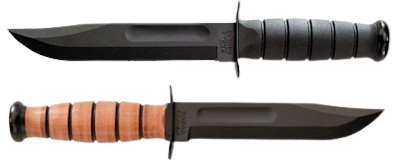
First adopted by the United States Marine Corps in November 1942 as the 1219C2 combat knife (later designated the USMC Mark 2 combat knife), little has changed in this weapon since it was first constructed...it's hard to improve on perfection. Besides use as a fighting knife, the Mark 2 has proven its usefulness over hundreds of years as a utility knife, used for opening cans, digging trenches, and cutting wood, roots, wire, and cable. Now made from a duranium alloy instead of carbon steel, the 30.16cm weapon with its 18cm long blade, is still a favorite of Marines.
Energy Based Weapons
Mark 2 Compression Pistol
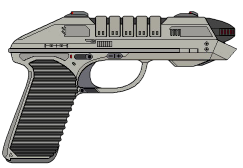
The standard issue side arm for the Marines is a combat-designed upgrade to the standard Type 2 Hand Phaser, this hand phaser fires a concentrated pulse that is more powerful than the standard beam fired from the Type 2. The phaser is arranged in a traditional pistol format with an extended trigger guard to allow ease of use by both combat troops and by those in EVA suits. The Mk 2 can also be magnetized to a surface for zero-gravity environments.
Type III Compression Phaser Rifle
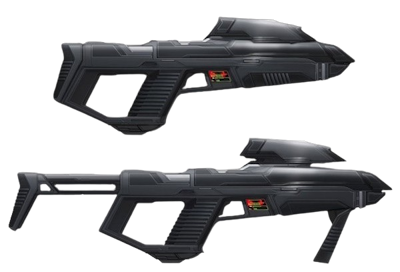
The most visible energy based rifle in the Marine Corps simply due to the fact it is also widely used by Starfleet Security, the Type III Compression Phaser Rifle is a dependable rifle with a long track record. Unlike it's predecessor, which was longer, more cumbersome, and less than ideal in close quarters, the current Type III rifle is more powerful and more versatile. With it's self-contained collapsible stock and forward grip, it ideal for close quarters situations and can be operated by one hand if needed.
The primary optics attachment is a powered ACOG style, though can be interchanged with Red Dot optics, a higher powered scope, a thermal imaging scope and a Hybrid sight that includes a swing able ACOG site and Red Dot sight.
The Rifle has several power settings ranging from stun to kill.
The Type III has several fire modes.
- Mode 1: Beam - Fires your standard phaser beam with an effective range of 600 meters.
- Mode 2: Single fire - A semiautomatic setting, firing one shot per trigger pull in a phaser burst setting. Effective Range of 500 meters for single target, 650 meters for area target.
- Mode 3: Burst fire - A semiautomatic setting, firing three shots per trigger pull in a phaser burst setting. Effective Range of 500 meters for a single target, 650 meters for area target.
- Mode 4: Fully Automatic - A automatic setting, fires phaser burst for as long as the trigger is held or the power reserve runs out.
PSR45 Particle Sniper Rifle

Based on the same compression technology as the Type IV Compression rifle, the PSR4 is a long range particle sniper rifle in use mainly by Starfleet Security with limited use in the Marine Corps. With almost double the compression coils as the Type IV, designed to fire phaser bursts over long distances, the PSR45 is an effective ranged weapon. With an extended barrel, built in targeting computer and an eject able magazine allows for the rifle to fire higher charged shots than typical of Phaser Rifle.
Different in design philosophy than the typical Starfleet phaser rifle design, the PSR45 follows a more traditional weapons design, allowing for better weapons control, high rates of fire and balances the longer barrel. Coming in at 61 inches from the end of the stock to the type of the barrel. The barrel and the compression coils built within it is long barrel of 28 inches, this design allows for the phaser burst to be fired and maintain its energy and power over much longer distances then the Type IV. To allow for these higher powered shots, the PSR45 has an eject able 5 shot magazine that fires a burst with three times the normal power output as a Type IV burst.
At the end of the barrel on the bottom of the rifle body is a rail where a bipod is typically mounted, whilst along the top of the body is a rail where typically the same x5 to x10 rifle optic from the ER98 is mounted. Additionally it can have any standard optics attached to the top of the weapon. As the same as the ER98, the ammo counter must be linked to the users HUD. Because it fires energy shots and not ballistic projectiles, most of the calculations are done by a targeting computer built into the stock of the rifle.
- The PSR45 Particle Sniper rifle has a single semi-automatic firing mode. It fires a high energy particle burst similar to a phaser burst of the MK5 and Type IV rifles. It has an on target effectiveness of 1500 meters before the burst begins to lose cohesion , the longest known PSR45 shot struck at 1762 meters.
SMPC MK3 (Shoulder Mounted Particle Cannon)
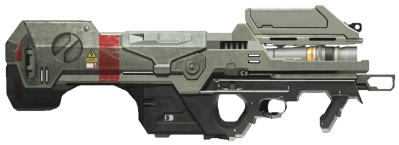
A combat oriented heavy weapon, similar to the Isomagnetic Disintegrator used by Starfleet, the SMPC uses a micro-accelerator to produce a high energy pulse of particulate energy that can be used penetrate armor, breach structures, or disintegrate its target.
Projectile Based Weapons
HFR25 SAW (Squad Assault Weapon)
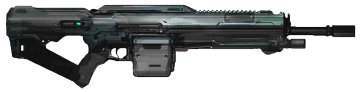
The HFR25 SAW, commonly or SAW is designed to give squads a high rate of rife weapon, capable of suppressing enemies for long periods of time with sustained fire and the accuracy of a rifle sized weapon. This air-cooled, gas-operated, drum fed weapon offers a very high rate of fire with a medium range making it ideal for covering retreating marines, or suppressing the enemy while making an advance. Made of the same Titanium/Duranium Composite, its relatively light for its size, extremely durable and able to be operated in any environment. Due to its high fire-rate ability and the increased changes of jamming or overheating in such sustained high fire-rates, the barrel is easily removed and replaced with a new one.
Generally of a rifle design though larger, the SAW is a whopping 45 inches from end of the stock to the tip of the barrel, this large design allows it to give sustained fire over a medium distances. Unlike other rifles used by the Marine Corps, the drum with rounds is located in front of the trigger, as a bullpup design in the case of this weapon would be impractical for sustained use, and wouldn’t be properly balanced. With a single firemode of fully automatic combined with its long barrel its accurate over medium distances despite the recoil and high rate of fire. Its most accurate however when fired in bursts, which is advisable in most situations. Because of its high rate of fire, the SAW has the largest magazine of any weapon, with a 100 round drum as its primary magazine. Also available is a 150 round extended drum.
Due to its ability to be mounted, the SAW has a round displayer on the top, right above which is a rail capable of having most optics mounted on it. To assist with stability, there is a long rail along the bottom of the weapon which generally has a vertical grip on it, just front of which bipods are almost always mounted.
- The HFR25 SAW has one available fire mode, being a fully automatic weapon with a high sustained fire rate of up to 980 rounds per minute. It has an effective on target range of 350 meters and an area of target effect of up to 500 meters. Accuracy is generally increased when fired in burst however, with on target effectiveness having been demonstrated at up to 430 meters in properly controlled burst and minimal recoil.
ER98 Ballistic Sniper Rifle

In need of a long range weapon capable of firing in almost any environment and keep their position secret, the Marines Corps started with the development of the ER98 Ballistic Sniper Rifle in the late 2360's, though it wasn’t introduced until the mid2370's due to a halt in development during the Dominion war. The ER98 is a semi-automatic, gas-operated sniper rifle meant to engage targets at some of the longest ranges possible, this allows it to be used in small two man scout teams. This rifle requires the user to receive special training to use, as unlike the PSR45, it requires extensive calculations in terms of range, round drop, wind, etc. unlike its particle counterpart. Based off of the same light weight, yet durable design principles, the body of the ER98 is made from a titanium/duranium composite. The Barrel however is made from a pure titanium material with rifling to increase its effective range.
The largest designed rifle in the Marine Corps arsenal, the ER98 is 64 inches in length from end of the stock to the tip of the barrel. Unlike all the other rifles in use by the Marine Corps, the ER98 follows a more standard rifle design with the magazines being inserted in front of the trigger, with the back of the magazine receptacle being part of the trigger guard. The Barrel itself makes up a majority of its length, with ~30 inches being just the barrel out of the front. Additionally to keep the rifle stable, the front of the rifle body includes a built in deployable bipod, behind which is a built in angled hand grip. Magazines for the ER98 supply four shots per magazine.
Generally restricted to long range optics, the standard optic on the top of the rifle is a multiple zoom optic with a x5 and x10 setting. Available optics dependent on user preference is x15, x20, x40 and though rarely used, as high as x60. Additionally, there are high zoom thermal optics available, as well as sensor based optics. Built into each mountable optic is a range finder and small targeting computer that allows for easier use, those trained in use of this rifle are trained not to depend on the targeting computer however. Like the LR7, the ammo counter must be linked to the users HUD.
- The ER98 has a single fire mod of semi-automatic. Though not designed for it, the ER98 has a sustained fire rate of 75 rounds per minute, with the highest accuracy rating of any Marine Corps rifle at almost any range. It fires a large 15x114mm round capable of puncturing light armor. It has the highest on target effective range of approximately 1900 meters, though this is disputable as the longest recorded shot to date comes in at 3528 meters.
Grenades
Photon Grenade
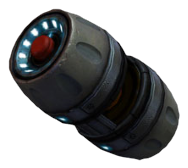
A .25 kilogram thrown weapon that delivers a powerful electromagnetic pulse within a 3 meter radius, with diminishing effect up to 10 meters. The photon grenade has two setting options: timer and power level. Both the top and bottom hemisphere of the weapon control these settings by turning and clicking them to the desired setting. Once set, the user would push the two hemispheres together, arming the grenade. A small button on top activated the timer. The grenade is capable of delivering a stun effect at low levels, as well as a lethal pulse at greater levels. The levels were similar to those used in phaser weapons.
Gas/Smoke Grenade
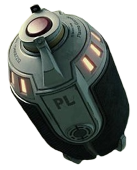
A .5 kilogram thrown weapon, this grenade will, upon detonation, produce a cloud of thick gas or smoke cloud for 50 to 90 seconds that will dissipate depending on the conditions. The grenade has a safety switch on the bottom of the grenade, and a timer activation button on top and has a 5 second timer. These grenades could be used to deploy various types of gases, as well as non-toxic smoke of various colors.
Equipment
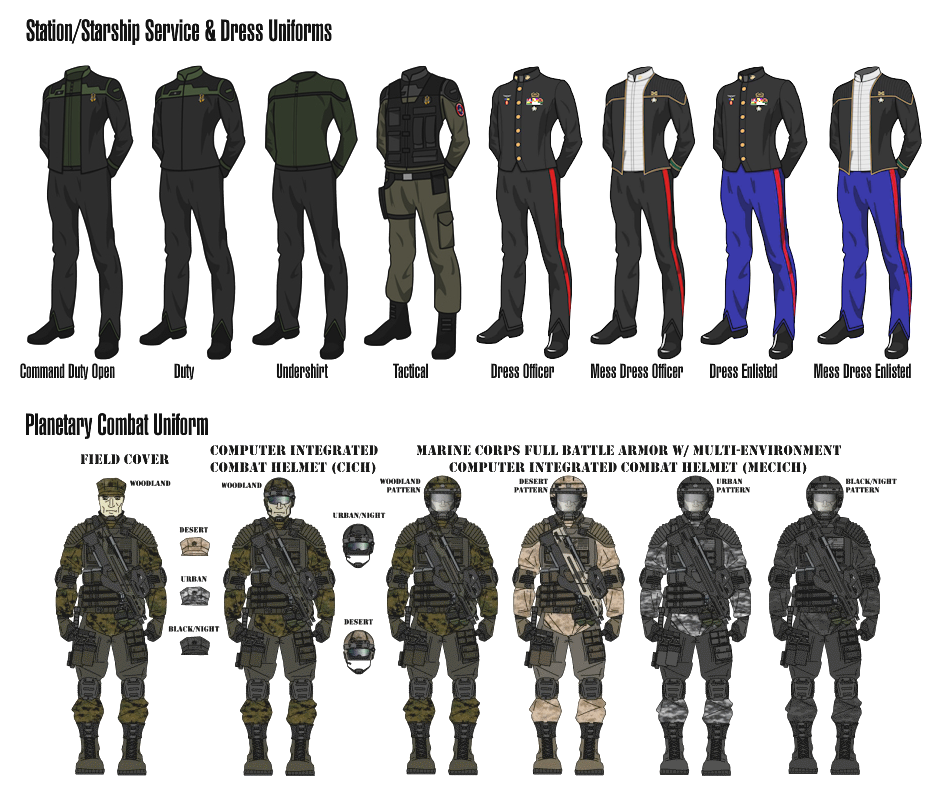
Uniforms
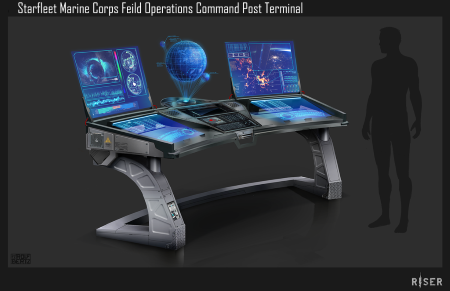
Forward Combat Command Station
Helmet Heads UP Display

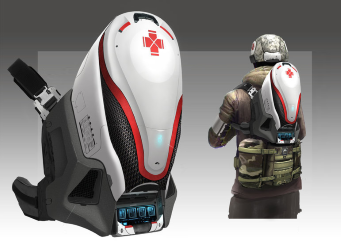
Corpsman Field Medkit
Marine Wrist Tricoder
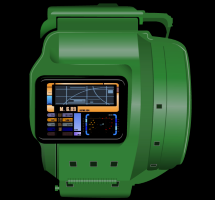
Facilities
Deep Space 5
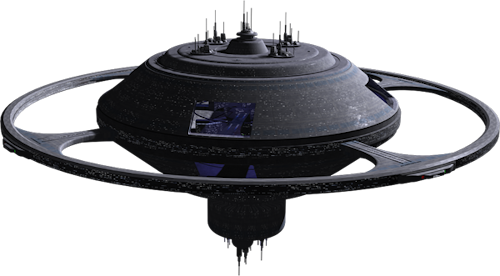
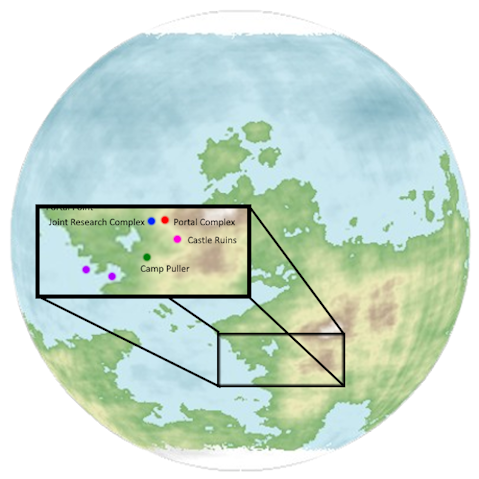
Headquartered on the Celestial class star base; the Marines of the 21st MEU operate on decks 72 & 73, and below on the planet Pangaea. The Marine Commanding Officer (MCO) reporting directly to the stations commanding officer.

Marine Corps Base Puller
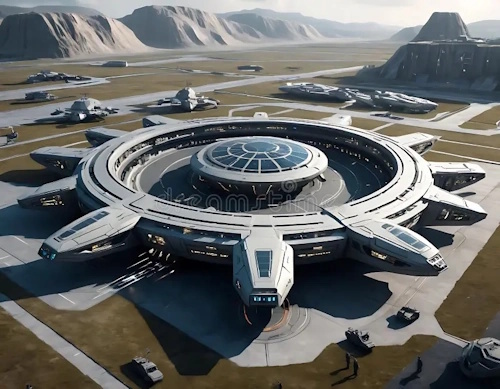
Named after Lt. General Lewis "Chesty" Puller, 1898-1971.
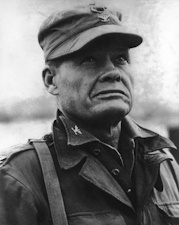
One of the most decorated Marines in history, "Chesty" Puller became symbolic of the esprit de corps of the Marines. Known for his insistence on discipline, he is known to have once come upon a second lieutenant who had ordered an enlisted man to salute him 100 times for missing a salute. Puller told the lieutenant, "You were absolutely correct in making him salute you 100 times, Lieutenant, but you know that an officer must return every salute he receives. Now return them all and I will keep count."
He also was attributed for several sayings still use today.
"Old breed? New breed? There's not a damn bit of difference so long as it's the Marine breed."
"Take me to the brig. I want to see the Real Marines",
"We're surrounded. That simplifies the problem...",
"Pain is weakness leaving the body", and
"Take good care of your men and they will take care of you."
Location:
Planet: Pangaea, on the larges continent in the southern hemisphere
Categories: Marines - 21st Marine Expeditionary Unit (MEU)